

Key Takeaways
There is no universal good ATS score. Learn what a CV match score measures, how to read yours against a UK job advert and raise it without keyword stuffing.
You paste your CV and a job advert into a checker and it gives you 62%. Is that good? Should you rewrite everything before applying, or is 62% fine for this role? The honest answer is that the number on its own tells you very little. What sits behind it tells you a lot.
This guide explains what an ATS score measures, why no single score counts as "good" everywhere, and how to read yours in three layers so you know exactly what to fix. You will also see a worked example and a list of edits that raise a score without turning your CV into a keyword list that a recruiter would reject on sight.
Quick answer
There is no universal good ATS score. Scores come from CV-checking tools, each with its own method, and employers do not see them. Treat your score as a checklist instead: make sure every essential requirement you genuinely meet appears in your CV in the employer's own words, fix anything that stops software reading your CV, and then stop. A CV that covers the essentials clearly will serve you better than one pushed towards 100% with words you cannot back up.
What an ATS score actually measures
An applicant tracking system (ATS) is software employers and recruitment agencies use to receive, store and manage applications. When you apply through an online portal, the system usually reads ("parses") your CV into fields such as name, job titles, dates and skills. Recruiters can then search and filter candidates, and many portals add screening questions, for example about your right to work or a required qualification.
Many UK employers use this kind of software, particularly larger organisations and agencies handling high volumes. Smaller employers may simply read every CV that arrives by email. Either way, a person usually makes the final decision about who is invited to interview.
An "ATS score" is something different. It is produced by a CV checker, not by the employer. The checker compares the text of your CV with a specific job description and estimates how closely they match. Depending on the tool, it may look at:
- skills, tools and qualifications named in the advert
- job titles and seniority words
- how often important terms appear, and where
- whether your CV's layout can be read cleanly by software
So a score is a useful estimate of overlap. It is not a prediction of whether you will be shortlisted, and the employer never sees it.
Want to see your own result? Check your CV against a job description and see which keywords are missing.
Why there is no universal "good" ATS score
You will see confident claims online that a particular percentage is the target. Treat them with caution, for three reasons:
- Every tool calculates differently. The same CV and advert can produce noticeably different scores in two checkers because they weight keywords, titles and formatting differently.
- Adverts vary. A short advert with five requirements is easier to match than a long one listing twenty tools, most of them "nice to have".
- Not every requirement carries the same weight. Missing an essential qualification matters far more than missing a desirable software package, but a simple percentage can treat them alike.
That is why the useful question is not "Is my score high enough?" but "Which requirements am I missing, and do I actually meet them?"
How to read your ATS score in three layers
Work through your results in this order. It keeps your effort on the changes that matter most to a human reader as well as to software.
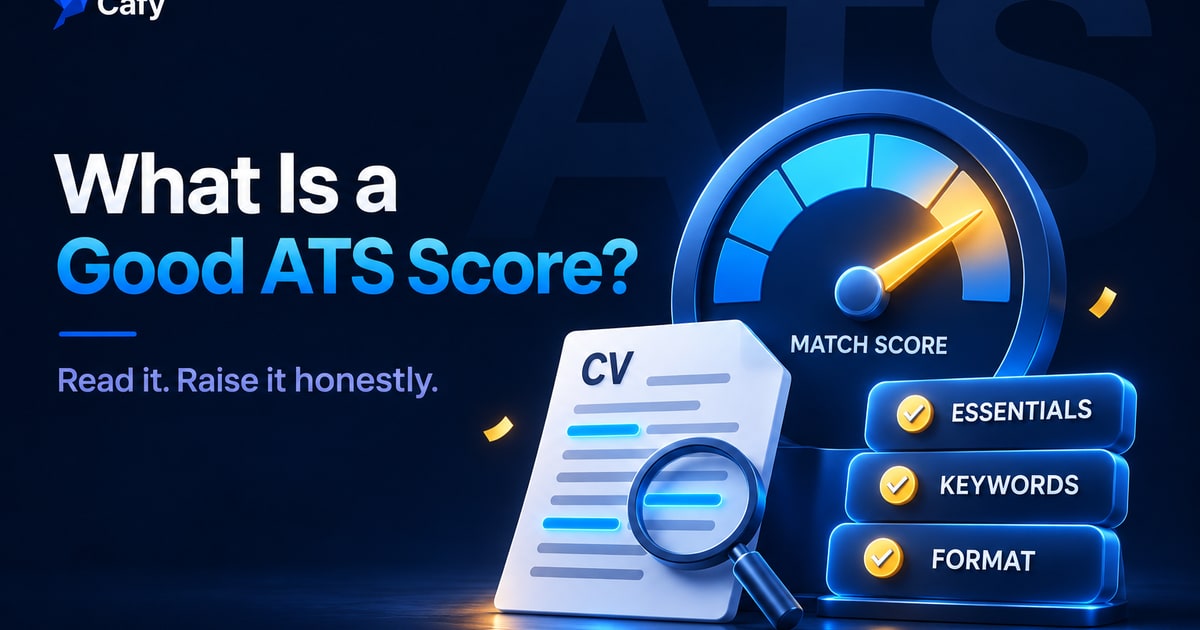
The three layers behind an ATS match score.
| Layer | What to check | What to do |
|---|---|---|
| 1. Essential criteria | Requirements marked "essential" or listed first in the advert or person specification | Make each one you meet impossible to miss, ideally with evidence in a bullet point. If you do not meet one, decide honestly whether to apply. |
| 2. Keywords and terminology | Tools, methods, certifications, sector terms and the job title | Use the employer's wording where it is true for you. Include both an acronym and its full form once. |
| 3. Format and parsing | Columns, tables, text boxes, headers, graphics and unusual headings | Use a single-column layout, standard headings and plain text for key information. |
If layer 1 is solid and layer 3 is clean, a middling overall score often reflects desirable extras rather than a real weakness.
See all three layers for any job advert
Cafy's ATS CV checker compares your CV with a specific job description, gives you a match score, lists the missing keywords and flags formatting issues, so you can fix them straight away in the CV builder. The free plan includes AI uses to get started, and Premium makes CV tailoring unlimited.
Check your CV free or see what each plan includes
A worked example
Here is an invented advert for a Customer Success Executive at a software company in Manchester, reduced to its requirements:
- Essential: two years in a customer-facing role; experience with a CRM such as HubSpot or Salesforce; managing renewals; excellent written communication.
- Desirable: experience in a SaaS business; confident with Excel.
Imagine a candidate with three years in a customer service team at a broadband provider. Their original CV said:
"Responsible for helping customers with account queries and keeping records up to date."
That line describes relevant work but misses every term the advert uses. Rewritten, with only true details, it becomes:
"Handled renewals and account queries for around 40 small-business customers a week, logging every contact and follow-up in Salesforce."
The new line now covers three essential criteria (customer-facing experience, a named CRM and renewals) and shows written communication through the job itself. The candidate also adds "Excel (pivot tables, VLOOKUP)" to their skills section because they use it daily. They do not add "SaaS", because they have not worked in a software business. Instead, the cover letter explains why their subscription-based broadband experience transfers.
That is the whole method: map each requirement to true evidence, use the employer's words, and leave genuine gaps visible rather than papering over them.
How to raise your ATS score honestly
- Mirror exact terms when they are true. If the advert says "stakeholder management" and you did it, use that phrase rather than "worked with different teams".
- Spell out acronyms once. Write "search engine optimisation (SEO)" so both versions can be found.
- Use the advert's spelling. Some checkers treat British and American spellings as different words. If the advert says "optimisation", match it.
- Put skills in two places. List key tools in a skills section, and show at least the essential ones in action in your work experience bullets.
- Use standard headings. "Work experience", "Education" and "Skills" are read reliably. Creative headings may not be.
- Keep the layout simple. One column, no text boxes, no key details in headers or footers, no skills shown only as icons or bars.
- Follow the file instructions. If the employer asks for Word or PDF, send that. If you send a PDF, make sure it is a text-based PDF exported from your editor, not a scanned image.
For a fuller walk-through of layout and keywords, see our guide on how to optimise your CV for UK applicant tracking systems.
When a lower score is perfectly fine
A modest score is not always a problem. It is often fine when:
- you meet every essential criterion and the gaps are desirable tools you could learn quickly
- you are changing career and your evidence uses different language from the advert (address this in your cover letter)
- the advert is very long and lists many optional extras
- the checker has missed a synonym that a human would understand
The reverse is also true. A high score does not guarantee interviews. If your CV matches well and you still hear nothing, the cause may be your choice of roles, the volume of applicants or timing. Recording each application and its outcome, as described in our guide to tracking job applications, helps you see which it is.
Mistakes that backfire
- Keyword stuffing. A block of repeated terms may lift a checker score, but recruiters read the CV too, and it looks careless.
- Hidden text. White text or tiny fonts with extra keywords can show up when your CV is parsed or highlighted, and it damages trust immediately.
- Copying the advert. Pasting the employer's sentences into your profile reads as generic. Use their terms inside your own evidence.
- Claiming tools you cannot use. Anything on your CV is fair game at interview. If you would struggle to answer a question about it, leave it out.
- Over-designed templates. Graphics, columns and skill bars may look good but can scramble the order of your information when software reads it.
Use the score as a map, not a target
An ATS score is most useful when you stop treating it as a grade. Read it from the top down: essential criteria first, then the employer's language, then format. Fix what is true and missing, leave honest gaps alone, and send the application. That approach serves the software and the person who reads your CV next.
Know what to fix before you apply
Check your CV against the job description, see the missing keywords and formatting issues, then update your CV in the builder in a few minutes.
Check your CV free or explore the AI CV builder
AI suggestions are a starting point. Review every change so your CV stays accurate and in your own words.
Frequently Asked Questions
There is no standard figure because each checker calculates scores differently. A good result is one where every essential requirement you meet is clearly shown, the important terms from the advert appear naturally, and no formatting issues are flagged.
Many do, especially larger employers and recruitment agencies that receive a high number of applications. Smaller employers may read CVs directly. Writing a clear, well-structured CV works for both.
No. The score you see in a CV checker is calculated by that tool. An employer's own system may rank or filter applications in its own way, but it does not receive your checker score.
Most systems can read a text-based PDF exported from a word processor. Problems usually come from scanned images, complex layouts or text inside graphics. If an employer asks for a specific format, use it.
For roles you really want, yes. Each advert uses different language, so a quick check against that specific job description shows which terms to add or move before you apply.
Yes, you can use it on the free plan with no card needed, which includes a limited number of AI uses. Premium plans make AI CV tailoring unlimited. See the [pricing page](/pricing) for current details.
More guides on CV, ATS and applications
- How to Track Job Applications: Spreadsheet or Tracker?
- How to Optimise Your CV for UK Jobs: ATS Guide for 2026
- Best AI CV Builder in the UK for 2026: CV and ATS Guide
- How to Write a UK Cover Letter: Format, Length and Structure
Tools for this step: AI CV builder, ATS CV checker and Cover letter generator.
This article is for informational purposes only and does not constitute legal or immigration advice. Rules change frequently - always check the current gov.uk guidance or speak to a qualified immigration adviser before making any decisions.